Something that is not discussed often enough in plein air landscape painting is the importance of landscape drawing. Looking through books on Corot or Levitan, you will see pencil, chalk, or ink sketches for nearly every painting they did, and a lot of landscape drawings that never became paintings. The Uffizi gallery in Florence has a large collection of landscape drawings. They used to allow people to copy directly from the original drawings for every artist except the major Italian Renaissance painters. I spent hours copying Corot’s landscape drawings as a student.
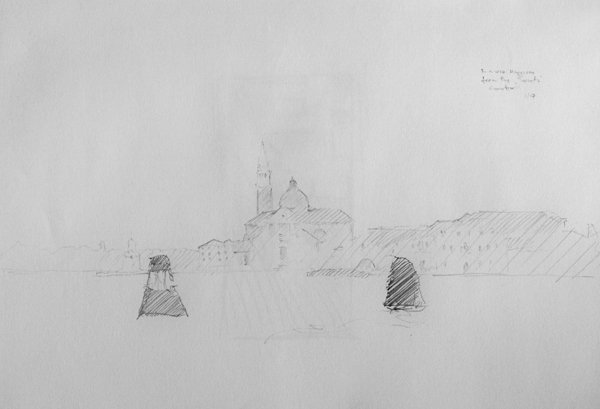
San Gorgio Maggiore from the Società dei Canottieri, Venice.
Often when I travel I’ll spend the first few days just going around with a sketchbook and pencil to scout out places to paint later. It is obviously much easier to move around, but I also find drawing the landscapes first helps me work out the compositions and also makes it quicker when I paint the subject later, having already done the drawing once.
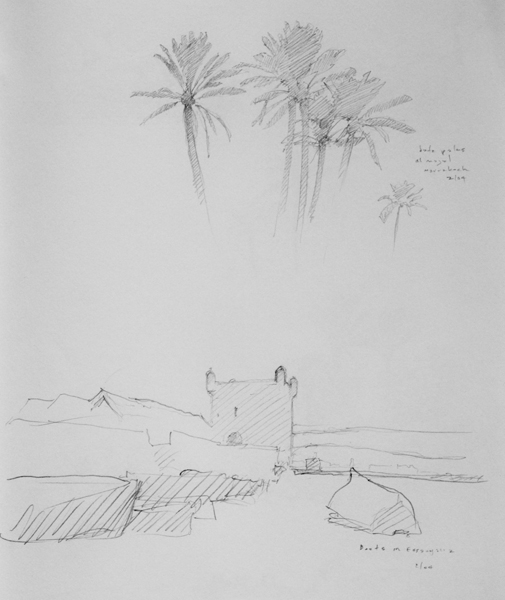
A page from my Moroccan Sketchbook. Palm trees in Marrakech and the Fort at Essaouira.
The sketchbooks are also fun to look back over years later as many of the paintings are long gone (or were never painted to begin with).
For larger work I will often do multiple sketches as well as small thumbnails to try to figure out the best balance for the final composition. Since I can’t trust the perspective from photographs, drawings are a much better source for large studio landscapes.
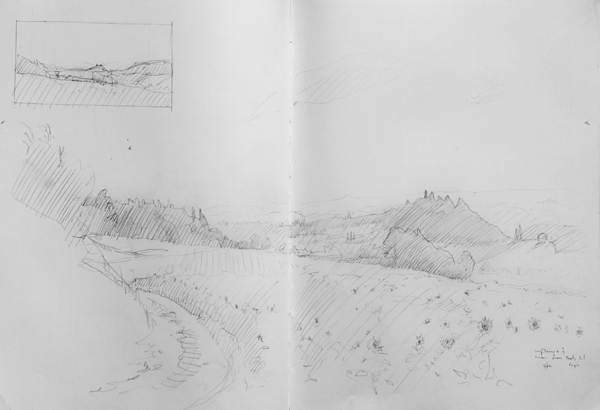
Sketch for Sosta del Papa (over two pages in my sketchbook).
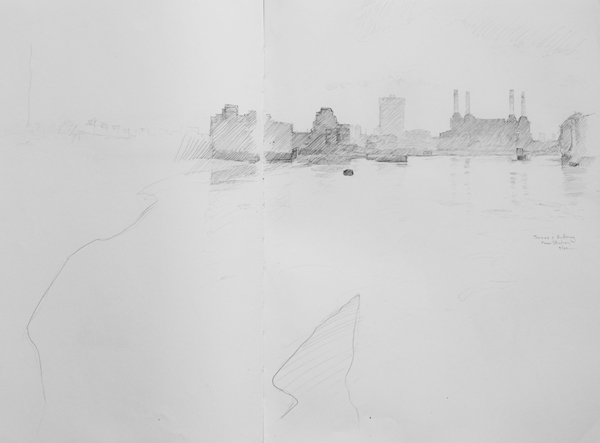
Battersea Power Station, London.
My favorite sketchbooks for landscape drawings are the 112 page, 8 x 11 inch Kusnt and Papier hardbound sketchbooks, I usually get them at New York Central Art Supply. I like the paper they use, they’re very durable, and the small amount of pages make the books very light and portable. The pocket-sized, blank-page Moleskines are good too. I use a kneaded eraser, any brand of HB pencil, and a small plastic retractable x-acto knife to sharpen it. Having a long, tapered, insanely sharp pencil lead is the trick to getting drawings to look decent (and lots of practice, of course).
Lovely stuff. Do you have any pencil/paper preferences? Do you ever record colours or do you rely on photos and memory for that?
Hello Andy, Thanks. I updated the post with the materials.
Thanks Marc. Looking at the consistent fine lines I’d assumed you must use a mechanical pencil of some sort.
I love the silhouettes on the palms and fort sketch.
Marc, any chance you could post a photo of a pencil sharpened the way you are describing? It may sound like an odd request, but I always enjoy seeing people’s materials the way they’re used. I’ve been using mechanical pencils myself for years, but mostly out of laziness and frustration with how hard it is to whittle a pencil (charcoal or graphite) to a perfect point. Maybe you could inspire me to get off my butt again. 🙂