This is the first of a two-part post on studio lighting. When I worked at Charles Cecil studios, a few of us were present at the opening of new studios and had to set up the lighting. It was a lot of work, but I came away with a good understanding of how to control light in a painting studio. (Apologies in advance for my photographic skills, but I hope to pick up a better low-light camera soon).
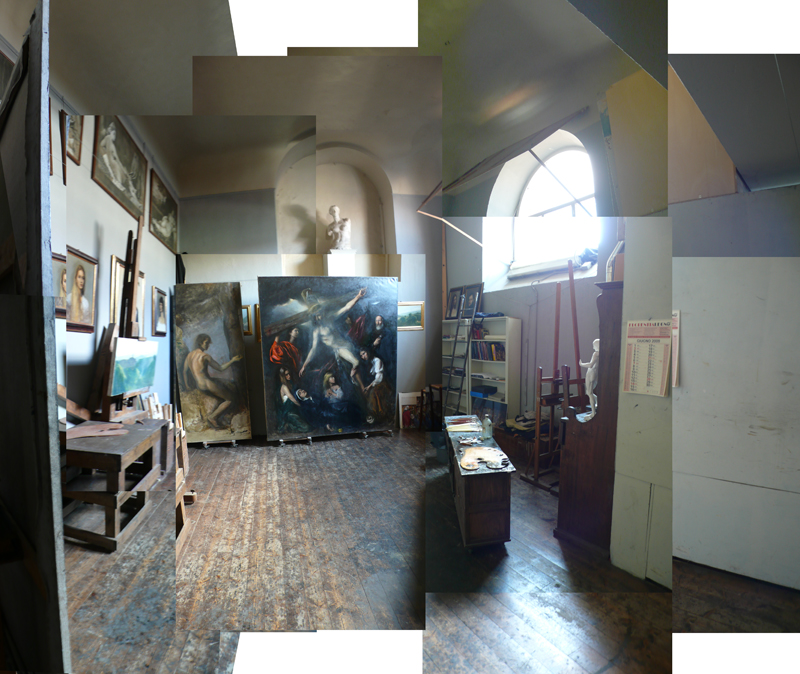
Charles Cecil's studio on Borgo San Frediano.
Most painters know that you need north light to avoid having direct sunlight moving around the room while you work (in the northern hemisphere only! I’ve heard of painters setting up north-lit studios in the southern hemisphere, only to have the studio blasted with sunlight). What they often don’t realize is how important it is to control the bounced light from outside as well.
One of the main errors I see in studio set-ups is not keeping reflected light off the ceiling. In a north-facing studio, anything you see from the window is facing south, and reflecting a lot of light. If you are blocking off the lower part of the window as most painters do, the light is still bouncing up onto the ceiling from the ground outside, and then coming down around the room. The best way to keep light off the ceiling is to put a hood over the top of the window. You can check the walls opposite the window to make sure the hood is keeping the reflected light out of the room. In my studio we just have a black tarp attached above the window with a wooden rod at the other end which is attached to a hook in the center of the ceiling.
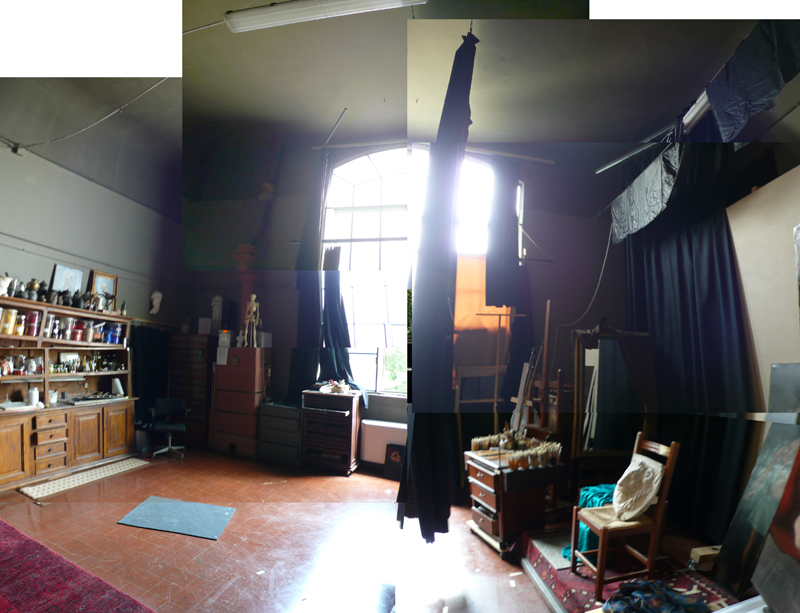
Daniel Graves's studio in Piazza Donatello.
The lower half of the windows in most studios are covered to get a higher light source and also keep out colored light reflecting off buildings and trees. Generally speaking, the smaller and higher your light source is, the more half-tones you see. In the photo of Daniel Graves’s studio above, you can see how he has run a curtain perpendicular from the middle of the window in order to have different amounts of light on the model and his working space. The right side of the window has a high, small light source for the model. The left side is flooded with light so he can see what he is doing.
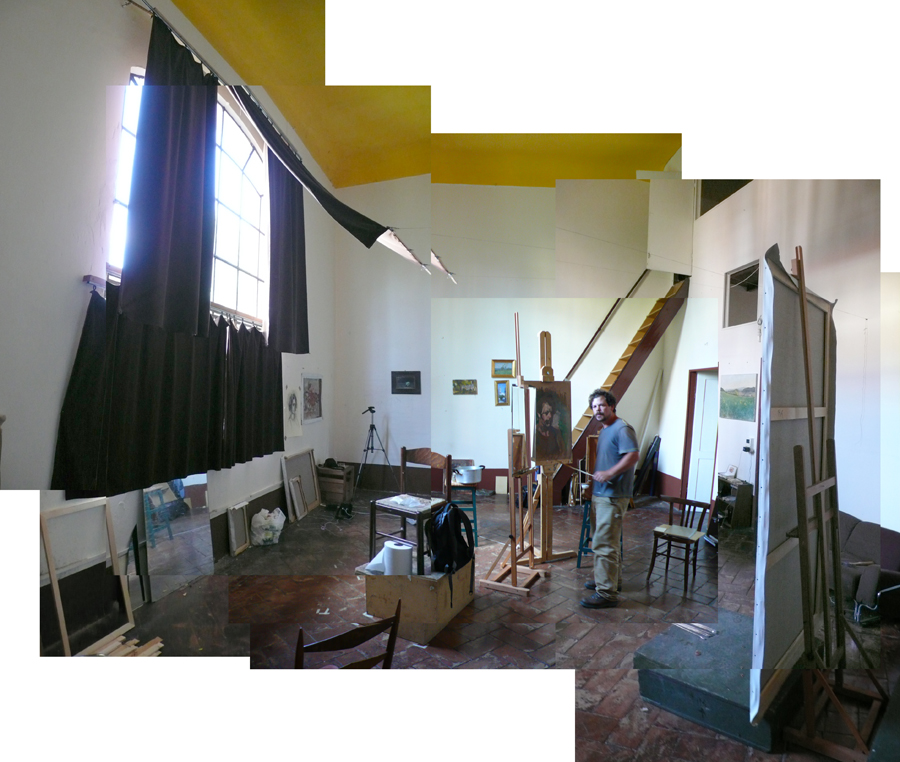
Ben Fenske in his studio in Piazza Donatello.
Ben Fenske paints some wonderful interiors with unusual lighting and in his studio he has light bouncing off the light walls, but still keeps light off the ceiling. In my Piazza Donatello studio (photo to be added soon) we have the walls covered with dark cloth to keep the subjects lit only from the window. In theory, if we ever needed reflected light, we could set up a light cloth on the other side of the subject. In practice, however, most traditional, naturally lit, paintings have only one light source. For portraiture especially, where working fast is of the essence, having a relatively simple pattern of light and shade makes everything much easier. Aesthetically, I also prefer the warm purple shadows you get with vermilion and black when painting a model lit with the cool light from a blue sky.
I was always taught about Rembrandt’s glazing and scumbling from warm to cool over the course of a portrait and how the different layers gave his sitters this wonderful pearlescent effect. Anyone who has ever painted a portrait under natural light will have noticed that over the course of the painting under changing light effects from the warm reflected light off clouds, to the cool light of the blue skies, chasing the effect naturally results in this layering of warm and cool layers in the paint. Just like so many old masters did before.
Terrific post, and just what I needed to read – keeping light off the ceiling, eureka! – I can’t wait until part 2. Thank you so much for your generosity in sharing your knowledge on this blog.
I helped Dan set up the panel in that back studio to block the reflected light from the ceiling (back when it was Cecil-Graves in the late 80’s-early 90’s). I remember it being a big concern for him. A very helpful post Marc!
Great post Marc. Very enlightening (no pun intended). I have often balanced canvases on the beams of my studio roof to try to control the light. I am always keen to see other painters’ studios and, having recently visited Whistler’s studio in Chelsea, I now have serious studio envy.
Hi dear,I would like to sownload ur manual.so please let me informed;thanks a lot..
Great post Marc! but we need part 2 🙂
Cheers!
Back in the 60s I worked in a studio on Via Margutta right off the Spanish Steps in Rome Italy for two years. The studio had the wonderful north light and set up as it should be with the bounced ceiling light restrained. That 300 year old studio is now gone and a condo/apartment replaces it. Horrors! Also the artist has has long since passed way . My studio is large and has large north light windows but has been a night mare to get the lighting right due to the lenght of the windows. The blog on lighting has gotten me working again on trying to fix it. It really makes a difference in how I paint.
Wonderful , wonderful paintings. Rebecca
I have a tiny north light window in my studio and want to add lights to suppliment the lighting.Should I put the lights over the window, around the window, or just forget this small window and put the light elswhere in the room? The room is long and narrow with a 9ft. ceiling that peaks down the lengh of the room. I also thought about putting the lights on the ceiling to simulate a skylight.
Any comments will be most appreciated.
Thank you for you information.
June Ward
Hello June, I wouldn’t block out the window with lights, but make sure they’re high enough to get a picturesque shadow pattern. A skylight can be good for halftones and makes the forms easy, but I personally find a really high is not ideal for portrait or still life work. I would have to see the room to really be of help though.
Hi Marc – thank you for your posts – very useful! I am currently looking to rent a place and convert it to a studio, so I want to get the lighting correct. This is stupid question, but i got confused when you say: “anything you see from the window is facing south”. So I wanted to clarify in case I was mis-understanding the lingo.
If I have a north-light window (which is what your post is about), then if I stand in front of my window and look out of the window and point my finger- my finger will be pointing south. Correct? So I will be south-facing and getting the north light. I am correct, or is it the other way around?
Thank you
I hope this thread is still alive. Great topic.I’m dyslextic with directions, so I want clarify. If I look out a north facing window, the forms I see are facing South AND are receiving South light. Correct?. So therefore it is important to block the bounce from these forms because the color temp, is shifting throughout much of the day. Correct? (unless I LIKE the bounce at certain times)
Now, the corallary might be interesting: I have South facing windows in my room, so the trees I see are receiving North light! Which explains why they look so good. So I have an excellent opportuniy to paint landscapes from inside my room without getting eaten alive by insects!
Last issue. Nobody mentions West light. I believe Titian utilized West windows to get his golden light. I’ve seen miracles happen to the Last Judgment at 6PM when the West light hits the wall in the Sistine chapel. And at the Academia in Venice when that light hits the panels with the gilded halos.
Ok. Never-mind. I think I answered my own question.
What I want is: If I stand in front of my window and point my finger – I should be pointing north.
This way, my window will not be getting direct sunlight, but reflected sunlight.
The most North wall is 30 degrees from true North.
If I put a window there will it be worth it?
Sure. You’ll get some sun in the summer either in the morning of evening (if it’s 30% east or west). But the rest of the time it will be perfect North light. More important is that nothing is reflecting light back into the studio (a tree or building outside the window).
Hello Marc,
Wonderful posts! I am in the unusual position of being able to choose my new studio location within a top floor loft with windows on 3 sides; I have to decide wether to have north facing or south facing windows. I am used to working with south facing windows and like the warmth of the light; however, its annoying that the light rays can pass along the walls. I paint from life and can put a skylight in the studio too. The skylight will be on a flat roof, and there are no buildings in from of the windows; ideally I want an even light on the walls but a warmth that comes from the sun and am wondering if the skylight will give this warmth to a north facing studio? Also, presumably a dome shaped skylight that is on a flat roof will have light changes directly under it in the studio as the sun passes across the sky? I could also take what I am used to , the south facing studio , and block off the light sometimes while painting under the skylight. Please let me know your thoughts especially about wether a skylight would warm up the quality of light in a north facing studio, many thanks, Gwen
I prefer the cool light of a north facing window, Gwen, since it gives the shadows a warm hue. I would imagine a flat skylight would get some direct sun in the summers, less so in the winters. Sorry I can’t be of more help.
Thank you…will keep thinking …just looked at your plein -air landscape paintings..love your paintings of trees /birch especially..theres real reverence for nature and light! I work from life too in a different way, studying light on the skin and magnified so that at times they look like landscapes; http://www.gwenhardie.com
What a great life; travelling the world with your paints and your eyes
I live in the southern hemisphere & am converting a big shed into a studio.
is it obvious that here, the light should come from the south, to have an effect equivalent to the northern light in the northern hemisphere?
many thanks for your response.
Heather Ellyard
Mountain Folly (outside of Maldon) Victoria, Australia
Hi Heather, I’ve never built a studio in the southern hemisphere, but that’s my understanding. You don’t want any direct sunlight hitting the window so the window should face south, towards the pole.
Hi Marc
Great insights
I live in Geelong in Victoria, Australia and thought I was “suffering “ when painting in a studio with south facing windows
I finally set up a studio with Northern light source only to be “blinded” by too much light
Back to a Southern light source today!
Part two is eagerly awaited
Cheers, Karen
hi Thank you for this post , it has been really informative , however I am in the Southern hemisphere and my studio has a north facing window … I like using natural light but obviously over the day the light moves across the window and changes on my set up , can you advise me what the best approach is is…should i resort to a studio with just artificial light ? thanks Ruby
Hi Ruby, yes unfortunately you will have moving sunlight and moving shadows with a north facing studio in the Southern Hemisphere. A dark curtain and artificial light could work if you want to work with stable light on sunny days.