Teaching

Umbrian Plein Air Workshop

Posted in Landscape, Teaching on February 4th, 2010 by Marc – Be the first to comment
Trevi Umbrian Plein Air Workshop

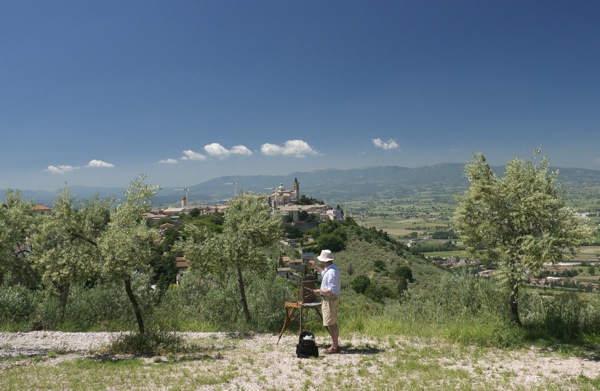
View of Trevi from the Bed and Breakfast.

I’ve posted the dates and location for the first of two plein air workshops I hope to do this June. The area around the town of Trevi in Southern Umbria really amazed me for it’s picturesqueness when I was in Spoleto a few years back. I’ve been back a couple of times since then to scout the place out and I feel it has incredible potential for a plein air painting location.

The town is also quite beautiful and without much traffic, if the group is interested in cityscapes.

Trevi2 Umbrian Plein Air Workshop

Picture taken in the center of Trevi this September.

For more information, head over to the courses page.

Sight-size in landscape painting

Posted in Landscape, Teaching on July 7th, 2009 by Marc – 2 Comments
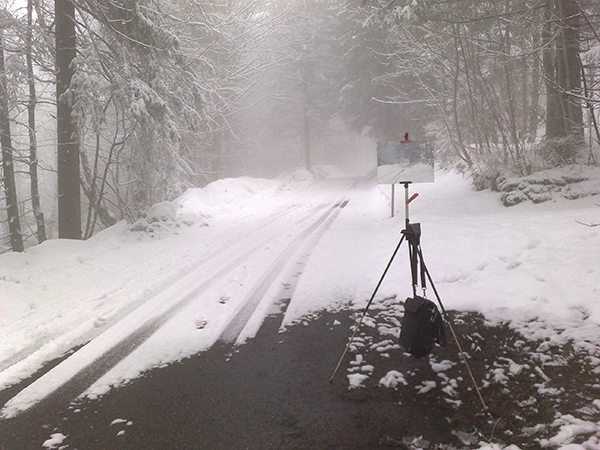
Using the sight-size technique for landscape painting.

Using the sight-size technique for landscape painting.

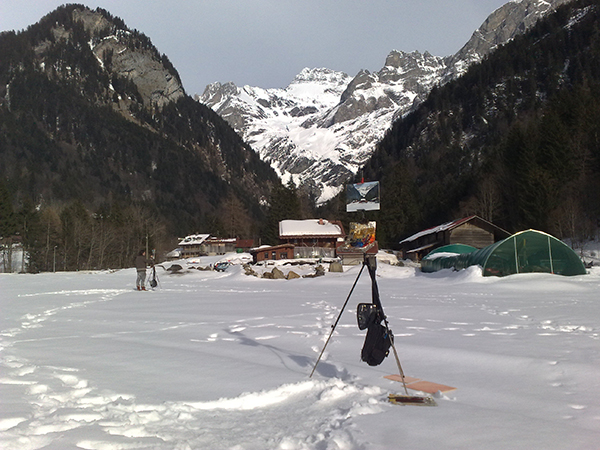
There is a lot going on right now in my life and haven’t been posting much. This is just a quick post to help better explain to my weekend landscape students the principle behind using the sight-size method for plein air sketching. In the photo above you can see how the camera was held in a position where the subject is the exact same size in nature as the painting on the panel. When using sight-size in the studio, the painter moves back to view the subject and the painting together from a distance. In the case of sketching the large view of a landscape onto a small panel with the sight-size method, the trick is to make sure your head is always in the right position where the subject ‘fits’ onto the panel. I personally believe many painters do this instinctively without realizing it.

The sight-size method is incredibly useful for landscape painting as it allows the painter to focus on the colors, values and edges, and the shapes almost seem to take care of themselves. For atelier-trained painters especially, who have spent years painting with the sight-size method already, it seems a waste not to continue using it outdoors.

Painting at the Badia a Passignano.

Painting at the Badia a Passignano.

Above is a panoramic photo of Wendy, Takuma and I painting at the Badia a Passignano this weekend.

The Long Island Academy of Fine Art

Posted in Teaching on May 21st, 2009 by Marc – Be the first to comment

liafalogo 700x233 The Long Island Academy of Fine Art

I gave a portrait demonstration two days ago at the Long Island Academy of Fine Art in Riverhead and talked about why sight-size is the best thing to happen to oil painting since lead white. The whole thing was filmed so I’ll try to put up a digital version when I get an edited copy.

For anyone looking for art lessons on Long Island, Jim Daga Albinson and Robert Armetta have done a great job setting up a couple of traditional painting ateliers in Riverhead and Glen Cove. They also get some excellent teachers for short workshops on a regular basis, and I know a few of the Florence Academy instructors will be doing short courses during the summer break this year, for those of you who can’t make it over to Italy.

Temperature

Posted in Teaching on April 27th, 2009 by Marc – 5 Comments

thermometer Temperature

The other evening Charles Cecil came to our open studio and, as usual, had a few things to say. One of the more interesting was a discussion on the use of temperature terminology when critiquing painting.

According to Charles, critiquing painting using the terms ‘warm’ and ‘cool’ was never done in R. H. Ives Gammell’s studio (where he studied) and is less accurate than describing the actual hue, i.e. too blue, too yellow, etc.

I find that using temperature to describe hue is much easier but not necessarily better. As a teacher, you get an immediate visceral reaction if something is too warm or too cool and it takes a second longer to figure out what the exact hue is. On the other hand, it is, at the end, much more helpful to the student both in the moment, and also in the long term to think in terms of hues and not temperature.

Charles’ exact words on the subject can’t be repeated on a family blog such as this, but I think he has a good point. At any rate, I’m now trying to get back into the habit of correcting student’s work by using hue and not temperature.

Edit: It was just pointed out to me that a quick search of Google books turns up a number of pre-1900 writings on art (notably Eastlake) which mention warm and cool, I still think it is less precise.

Saturdays in the Corsini Gardens

Posted in Landscape, Teaching on April 25th, 2009 by Marc – 1 Comment
Sean and Sara painting this morning.

Sean and Sara painting this morning.

At the moment I am teaching the Florence Academy of Art’s landscape painting class along with Jordan Sokol. Princess Giorgiana Corsini has generously given us the use of the private gardens at her palazzo, which is one of the more beautiful places to paint on an April morning. I took a few pictures this morning as the place is so stunning.

One interesting thing about the course in general is that the advanced painting students tend to have more difficulty that the intermediate group.  I think they assume that because they have painted so much in the studio already that it should be just the same outside. It is actually very different, and they tend to get frustrated quicker that the students with less experience in painting. Another problem I notice every year is that the students bring the wrong materials and think they can just wing it. Painting is so difficult even when your materials are all perfect, it becomes almost impossible if you have missing or incorrect equipment.

This year the class is going well. Today was only our second meeting and already the work is showing great improvement.

Judson painting a backlit view.

Judson painting a backlit view.

Pablo painting the portico.

Pablo painting the portico.

Ten books on painting

Posted in Materials, Teaching on April 12th, 2009 by Marc – Be the first to comment

books1 Ten books on paintingThese are the ten books on art which have had the most influence on me as a painter over the years. I haven’t listed them in any particular order. I should mention that these are all books for reading, without color reproductions. Clicking on the titles takes you to the Amazon.com (U.S.) page for each book.

The two children’s books which I still remember from when I was a small child are  Ed Emberley’s Drawing Book: Make a World by Ed Emberley and Frederick by Leo Lionni. If you want to keep your child from becoming an artist, these are two books you should avoid.

If anyone has other great art books to add, please put them in the comments.

Summer class schedule

Posted in Landscape, Teaching on April 6th, 2009 by Marc – Be the first to comment
Plein air painting of Volpaia (70 x 100 cm), one of my workshop painting spots.

Plein air painting of Volpaia (70 x 100 cm), one of my workshop painting spots.

I’ve posted the summer plein air workshop schedule on the ‘courses’ page on my website.  Every year I take three students on weekends in June and July. We stay in a small Tuscan farmhouse about 40 minutes from Florence near Tavarnelle val di Pesa. Places are already filling up, so if you know you’ll be in Tuscany and would like to take an intensive plein air landscape painting workshop, shoot me an email and I’ll save you a spot. The house is charming but not luxurious (there is often a young family with us), and the focus of the weekend is on painting. You can click forward on the calendar below to see the dates.

There is also the possibility of using a house by the beach in Maremma in June if I get enough interest.

Month: Year:
« Prev March 2010 Next »
Monday Tuesday Wednesday Thursday Friday Saturday Sunday
1 2 3 4 5 6 7
8 9 10 11 12 13 14
15 16 17 18 19 20 21
22 23 24 25 26 27 28
29 30 31        

Some thoughts on teaching

Posted in Teaching on October 12th, 2008 by Marc – Be the first to comment

teaching Some thoughts on teaching

As a working painter, I have always tried to avoid teaching. When I taught in the past I always had too many students, inconvenient schedules, and found my own work suffering to the point where I was having trouble meeting my commitments with galleries. This year however, after getting married, I decided the stable income wasn’t such a bad idea and I began taking students again.

The difference this time however is that, working for myself, I have taken them in very small numbers. From 1 to 3 students at a time, and I work alongside them. This summer I tried it out in the countryside with landscape painting and just basically dragged the students to the spots where I was already working and let them set up alongside. I would do demonstrations and give regular critiques, but I found that it didn’t affect my work at all. In fact I ended up painting more this summer than I have in the last few years. More importantly though, the steady (though small) income took off some of the pressure of the gallery production grind, so I was able to work at a much slower pace. In the end I think my work actually improved due to the teaching. The students, of course, appreciate the small class size and get a lot of information in a short period of time.

This winter I intend on continuing with small numbers of students in the studio. At the moment I’ve begun portrait projects with one student at a time, sharing a model.


Better Tag Cloud